Five Minute Vagus Nerve Calm Guide
A gentle routine for moments of stress or anxiety.
Your vagus nerve helps your brain and body communicate and supports functions such as heart rate and digestion. Comfortable slow breathing may help you settle. Here, “reset” means taking a calming pause; it does not mean repairing or switching off a nerve. [1,2]
Download the free illustrated 2-page guide (PDF)
Your five minute routine
Use this seated in a safe place. Keep your eyes open if that feels better. You can skip any step and breathe normally instead. The routine is intended for adults.
0:00–0:30 | Settle and look around
Rest your feet on the floor and support your back. Release your jaw and let your shoulders soften. Slowly notice three things you can see and the feeling of the chair beneath you. There is no need to force relaxation.
0:30–3:30 | Breathe gently into your lower ribs
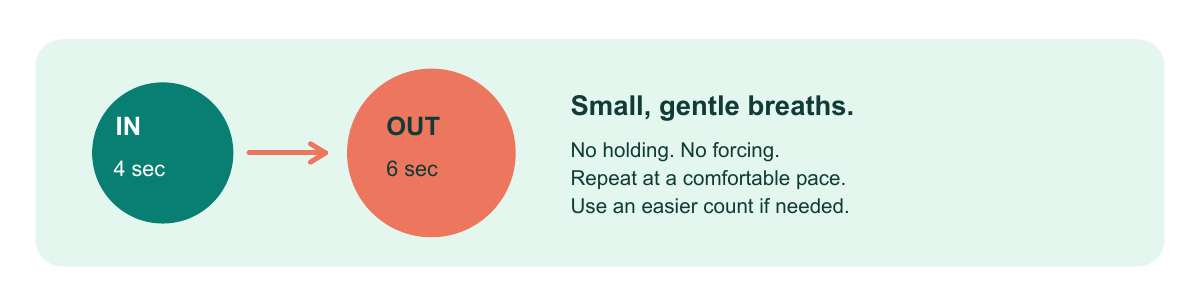
Place one hand on your lower ribs and one on your belly. Breathe in gently through your nose for 4 seconds; allow your belly and lower ribs to expand. Breathe out softly through your nose or mouth for 6 seconds. Let your ribs settle without squeezing the breath out.
Repeat for 3 minutes: about 18 breaths. Use ordinary, comfortable breaths rather than very large breaths. Do not hold your breath. If 4 in/6 out feels difficult, try 3 in/4 out, or simply breathe at an easy pace. 5 in/5 out is another comfortable option. [2,3]
3:30–4:30 | Hum on the exhale
Take a gentle 3–4 second inhale. With your lips lightly closed, hum a soft “mmm” for about 5–6 seconds, or less if needed. Keep your throat relaxed and the sound quiet.
Try 5–6 comfortable rounds. If humming irritates your throat or feels awkward, continue the breathing step instead. Humming is an optional way to make the exhale steady; it is not a proven nerve reset. [4]
4:30–5:00 | Reconnect and choose one next step
Return to your natural breath. Notice your feet and look around the room. Choose one small next action, such as getting water, taking a short walk, or asking for support.
If cooling feels soothing and is suitable for you, gently splash cool, not ice-cold, water on your face or rest a cool damp cloth on your cheeks and forehead for 10–15 seconds, keeping your nose and mouth clear. Continue breathing normally. This is optional; skip it if it feels unpleasant. [5,6]
Practice: Try one five-minute session daily when you are already fairly calm. Use it as needed during ordinary stress. These are flexible starting ranges, not proven treatment doses; the combined routine has not been tested as one protocol. Feeling no change does not mean you did it wrong.
Optional practices for another time
Choose one that feels helpful. These do not all need to fit into five minutes.
Breathing positions
- Supported sitting: Feet on the floor, hands on the lower ribs. Use the breathing step above.
- Lying on your back: Bend your knees or place a pillow under them; support your head. Let your belly and ribs move gently.
- Side lying: Support your head and place a hand on the upper-side lower ribs. Notice gentle expansion beneath your hand.
In any position, begin with 6–10 easy breaths, then continue for 3–5 minutes if comfortable. Air enters your lungs; “belly breathing” describes movement, not breathing air into your abdomen.
A gentle sigh
Take one comfortable inhale through your nose, add a small second sip of air if comfortable, then release a slow, easy exhale through your mouth. Try 1–3 rounds, then breathe normally. Avoid repeatedly taking maximal breaths. Research studied repeated sighing for five minutes daily over a month; these few rounds are a shorter adaptation, not a proven instant fix. [7]
Warm salt-water gargle
For throat comfort, dissolve ½ teaspoon of salt in about 1 cup/240 mL of warm water. Take a small sip, gargle gently for 5–10 seconds, and spit it out. Try 2–3 rounds; do not swallow the solution or gargle to the point of gagging. Plain warm water is an option if salt irritates you. Skip gargling if you have swallowing difficulties or tend to choke. Salt water is used for sore-throat care; a vagus or anxiety benefit is unproven. [8]
Gentle gaze or finger tracking
Keep your head comfortable and still. Look slightly right for 5–10 seconds, return to center, then slightly left for 5–10 seconds; try one round. Alternatively, hold a finger at a comfortable arm’s distance and slowly move it a little right and left, following it with your eyes for 2–3 gentle passes. Stay within a comfortable range. Stop for eye strain, headache, dizziness or double vision. These are optional attention exercises with no established vagus-reset benefit or effective dose. You do not need to yawn or sigh for them to “work.”
When anxiety feels intense
If focusing on breathing makes things worse, stop counting and use your surroundings: name 5 things you see, 4 you feel, 3 you hear, 2 you smell and 1 you taste. If a sense is unavailable, name another visible object. Take your time; you can use grounding instead of the entire routine. Contact someone you trust. [9]
Stop any exercise that causes dizziness, tingling, air hunger, pain, nausea, palpitations or greater distress. Return to normal breathing. Skip cooling unless a clinician has said it is suitable if you have heart disease, a rhythm condition, recurrent fainting, significant circulation problems or cold-triggered reactions. Cold plunges, face immersion and breath holding are outside this guide. Never press on your eyes or massage the front or side of your neck to “stimulate” the vagus nerve. [6]
Get help: New or severe chest pain, fainting, severe breathing difficulty or sudden neurological symptoms need urgent medical assessment; do not assume they are anxiety. In the US, call 911 for an emergency. If anxiety keeps returning, affects sleep or limits daily life, seek appropriate medical or mental-health care. This guide supports coping and does not replace treatment. [10]
Sources and evidence notes
Prepared October 7, 2026. Educational guide from Lifestyle Healing Chiropractic and Coaching. Exact counts for optional exercises are conservative suggestions, not validated prescriptions.
- Vagus nerve and brain–gut communication, 2017
- NHS breathing exercises for stress, reviewed June 2026
- HRV biofeedback methods review, 2023
- Humming and nasal nitric oxide, 2002
- Cold facial immersion and panic symptoms, 2021
- Cold-water immersion and autonomic conflict, 2012
- Brief structured respiration trial, 2023
- NHS salt-water gargling, reviewed April 2024
- NHS Inform grounding exercises, accessed October 7, 2026
- NHS panic disorder and urgent breathlessness guidance